

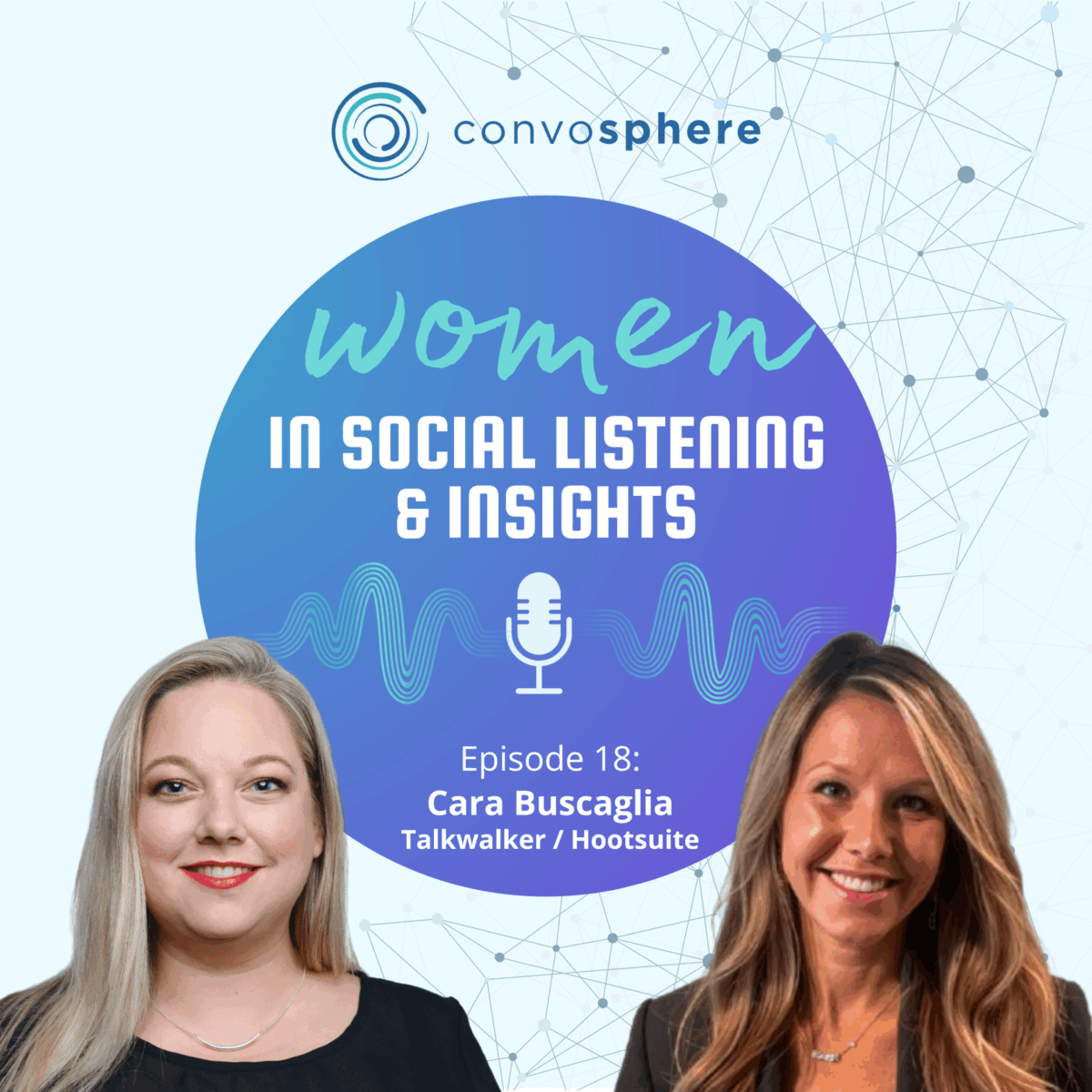
A Podcast Series Dedicated to the Women in Social Listening and Insights
Jackie Cuyvers meets Cara Buscaglia from Talkwalker / Hootsuite
In this episode, Jackie Cuyvers is joined by Cara Buscaglia, who leads strategy and innovation at Talkwalker (now part of Hootsuite), to explore how social intelligence has evolved — and what it takes to keep pace as platforms, data and AI reshape the industry. Cara shares her unconventional route into social listening, from an early career in PR and market research to nearly a decade helping brands turn billions of online conversations into actionable insight.
The conversation covers what “speed” really means today (separating signal from noise in real time), the challenge of democratising social listening across organisations without losing rigour, and why the next leap forward will come from connecting social data with business metrics like NPS and sales. Cara also discusses the importance of global frameworks with local nuance, ethical and compliant data use, and her belief that curiosity — not perfection — is what drives the most meaningful progress in modern insights.
Time Stamped Overview of the Podcast
00:00 – From PR to Data Analytics
05:31 – “From PR to Social Intelligence”
08:25 – “Speed and Real-Time Decision-Making”
12:57 – “AI Simplifies Tasks, Unlocks Potential”
15:35 – Global Innovation Through Local Frameworks
19:41 – Monitoring Brand Presence Everywhere
22:18 – Building Social Intelligence Through Workshops
27:25 – Localisation Challenges for AI Platforms
30:06 –”TalkBooker Launches Agentic AI Yeti”
32:50 – Ethical Compliance in Data Usage
36:05 – “Balance, Growth, and Self-Acceptance”
Podcast Transcript
Jackie Cuyvers:
Welcome to the Women in Social Listening and Insights podcast, where we showcase the incredible work of women working in the field of social intelligence. My name is Jackie Kyvers, and I’ll be your host for this journey. In this podcast, we’ll be speaking with women from enterprise, agencies, and academia who are leading the charge in the world of social listening and insights. Together, we’ll be exploring their careers and the challenges they’ve faced and overcome and the innovative solutions they’ve developed. Our goal is to provide valuable insights and advice to our listeners who are passionate about this field and committed to advancing their careers. Whether you’re a seasoned professional or just starting out, you’ll find inspiration and guidance in these conversations. So sit back, relax, and get ready to learn from the women who are shaping the future of social intelligence. Let’s get started.
Jackie Cuyvers:
Today I’m joined by Cara. Cara, could you tell us a little bit about yourself and what you do?
Cara Buscaglia:
Awesome. So excited to be here, Jackie. Thank you so much for including me. My name is Kara Biscagliot and I lead strategy innovation at Talkwalker, who was acquired by Hootsuite. I’ve been there, oh my God, like coming up on a decade, which is pretty wild at this point. And it’s been a great journey as this industry has evolved. Just for those of you who don’t know, I’ll give you a little bit of context on Talkwalker and Hootsuite. So Talkwalker is a social listening company that takes billions of publicly available conversations that are happening across online news, blogs, forums, and social networks and podcasts like this one here.
Cara Buscaglia:
To make leverage AI to make sense of all that data, those billions of conversations, to turn that into actionable insights that you can leverage across the entire business. And a perfect way to action those insights is through Hootsuite, through publishing and engaging on social media, and then being able to manage those channels and improve customer experience from that perspective. Also, while empowering your employees to be advocates for for your brand. So really the perfect suite to support, you know, the industry and the customer needs from that perspective.
Jackie Cuyvers:
So what brought you into this field of social intelligence and insights? I mean, you’ve been at Talkwalker and now Hootsuite, as you said, 10 years, but what was, what was your path to get here?
Cara Buscaglia:
I’ve got a really interesting path. So let me tell you. So I actually came to New York City with no job. In a subletted apartment and just was like a young girl full of hopes and dreams. And I started passing out my resume to like nearby restaurants and bars while I was like applying for jobs. Got a bartending job because a bartender didn’t show up to their shift. I’ve never bartended before in my life. And I start— I think that was my first entrance into listening because I was listening and overhearing conversations and forming connections with people, which actually got me fired because I was more focusing on those relationships over making the drinks.
Cara Buscaglia:
And then luckily due to that, I got hired at my first internship, which led to my first job in PR. And I fell in love with storytelling and measurement and how I could be more effective to getting those placements. But I didn’t feel like impressions were really, really a key indicator of whether I was being effective. So I made the decision to shift from PR to more of the PR marketing analytics side and leveraging market research. And so I, I worked at a company that really had their own paid earned and owned tool, and this was like 15+ years ago at this time. And I just became enthralled with combining different data sets together to tell story. So covering more earned and owned and then being able to pull in different market research to complement that, especially on the reputation side, et cetera. And it was at that point where we had this own tool that we were leveraging to monitor, and the founder of Talkwalker actually sold into me to replace that tool because we weren’t willing to make that investment. And I gave me the opportunity to really be his right hand and build out the strategy for Talkwalker. And so, gosh, I know that was a lot, but I think it’s an important part of my story because it It really has put me in this position where I can see all angles of this industry, and it helped me build out the strategy from that perspective for Talkwalker to support those different buyer groups.
Jackie Cuyvers:
Wow, that’s quite the journey.
Cara Buscaglia:
I know.
Jackie Cuyvers:
And are you still in New York?
Cara Buscaglia:
I’m not in New York. I was one of those people that temporarily in the cold winter months a couple of years ago moved down to Florida temporarily, St. Petersburg, and then decided not to leave. I was like, oh, it’s nice to be warm.
Jackie Cuyvers:
Yes, I definitely do not miss very cold winters. So you started in PR and communications before, you know, moving into that market research, intelligence, and data. How has that background helped you approach Insight work differently?
Cara Buscaglia:
Oh, I, I cannot express how I think starting out as a PR and comms practitioner truly gave me the foundational knowledge to spearhead my career in social intelligence. You know, think about, you know, from PR perspective, you know, having an understanding of media and how that functions and how that’s evolved over the year, I think, is a really critical foundation. I was working on and getting PR placements. And I think that slowly led to being more curious on, okay, what’s the impact of that? And being able to understand how to measure that effectiveness. And then once I kind of figured that, I was like, well, okay, now I, I want to understand the audiences around that. And that’s where market research came to be. And so I think it gives me such strong tools around storytelling, data curiosity, and the ability to understand the complexity and the evolution around the industry. Because before social listening existed, it was media monitoring, and that’s where I really started out a lot of my, my analysis.And that is just a, a version of social listening because it was hand coding. And Jackie, I’m sure you’ve done this— hand coding articles based on keywords and sending that out to a pool of analysts to hard code those articles so So you could turn those into insights and reports to evaluate if the brand made an impact with their com strategy. So to me, it’s just a continued layer and fed my curiosity on how data can tell a story and can give you a deep breath and insight into consumer behavior.
Jackie Cuyvers:
It’s funny that you you mentioned, know, back in the day, the manual coding, because as much advancement as there has been with technology, I mean, in many of our projects, we still need to do it to understand, you know, the nuance, the depth of, of the complexity of the conversation. So, so, so it’s, it, it’s not completely gone away. I think it’s one of those things that’s here to stay.
Cara Buscaglia:
I couldn’t agree with you more, Jackie, on that. I think tech— what I think was, is beautiful about technology is it gives you instead of having to look for those keywords or topics or categorization, it does that for you so that you can spend more time diving into the data to build out the strategy. And so I think it’s an evolution of, you know, doing the work to driving more insight with the work and with less resources.
Jackie Cuyvers:
Absolutely. In your article, Social Media Trends 2022: Scream if You Want to Go Faster, you emphasized speed and relevance. What does speed mean today in terms of social intelligence to you?
Cara Buscaglia:
So it’s a— this is an interesting question because when I, when I talk about speed and social intelligence today, I’m not really talking about chasing every trend on the internet. And I think speed to me and to brands that I work with and agencies and partners is being able to separate the signal from the noise instantly and turning that signal into something that a business can act on before the moment passes. And I think with consumer behavior and culture and platforms moving faster than ever, a trend can emerge on TikTok in the morning, shift to Reddit by lunch, and shift sentiment in that direction, and then hit mainstream news by dinner. And so I think it’s really important to have something that’s real-time, always-on in in addition to maybe more of those strategic, more in-depth reports. So when I think about speed, it’s really those two things. It’s detection and decision-making. So it’s the ability to detect those shifts as they happen, whether that’s a brewing risk or maybe a cultural movement or even a, you know, a product opportunity, and then translate that into action across the org. And I think that AI has really paved the way for brands’ ability to, you know, take these billions of conversations and actually distill it down in real time to give themselves a competitive advantage. So if you’re not doing that, I don’t know how you are growing in this day and age, truthfully.
Jackie Cuyvers:
Yeah. Well, and in order for that to be successful, then you need the plan and the people as well, right? Like, so you’ve got that information, but you already need to have some type of decision-making decision tree or pathway of what type of action should be taken and an understanding of who’s going to do it and how, and that they have the approval and means to do so.
Cara Buscaglia:
Absolutely. I think you bring up a great point, Jackie, about a framework, right? I think social listening isn’t something— it isn’t a crystal ball, let’s say. And so you really need to understand your objective. And what you’re trying to achieve, and real-time insights need to flow into that. So are you focused on measuring your brand reputation? Are you focused on trend? If you’re focused on trend, are you looking across a specific category? Are you looking snacking versus meals at home? Are you looking at beauty makeup trends versus skincare trends? So it’s having these frameworks set up so that you can be successful.
Jackie Cuyvers:
Yeah, you’ve spoken about the goal of democratizing social listening, making it easier for more people to use. What, in your opinion, still stands in the way of that?
Cara Buscaglia:
I mean, when I think about the biggest barrier to truly democratize social listening, I think it’s still that people are overwhelmed with the noise. And the noise is morphed into in different areas now. It’s noise on social, just like promotions, etc., but it’s bots and it’s also misinformation. And so it’s, it’s a very unstructured, messy data set, which I think can be a little daunting to some people. So when companies have access to a platform, a lot of people don’t really feel that confident diving in because they’re afraid of misinterpreting it missing something important. And I think, so I think that’s a, a really big barrier. Another big barrier I think is the understanding component. I think social listening has historically lived with specialists, right? Analysts, insights teams, comms.
We know that best, Jackie, from that perspective. And it, that was our people who know how to build Boolean, filter out spam, translate conversations into patterns. And I think the reality is we want social intelligence to really be embedded across a business. And in order to do that, we have to figure out how to meet people where they are. And that means making these insights instant, understandable. And so people don’t have to be a data scientist or an analyst. And so it’s really about why this matters. Around a trend, and it means using AI to remove complexity. Now, I want to be very clear when I say removing AI, it’s not removing people. It’s removing tedious tasks and cleansing that so that people can help drive and prompt the AI to help support that. So democratization isn’t just about giving people access. It’s about breaking down those blockers. And so I think when we solve for those, we’ll get more access to product teams, innovation, care. So I think that’s a really important part of it. The next part I also think that I have to, to take note on that I think is important is the correlation of data that I think is also critical to unlock barriers and being able to tie social next to NPS brand trackers or sales numbers traditional market research, I think that will also help it fit into the bigger picture. That’s what truly excites me the most about social data is when it’s correlated with other datasets, because I think it just substantiates the business question and intent even further.
Jackie Cuyvers:
Leading strategy and innovation for Hootsuite, how do you prioritize which capabilities to build or adopt?
Cara Buscaglia:
Oh yeah, I think this answer is, is, is simple for me. It just always comes back to the customer. I always say fall in love with the customer problem. It’s so important to understand their problem, but then also their workflow. Where’s the friction in what they’re doing today? How do we help them move the needle to work faster, simplify those workflows so they can get to those outcomes faster? So when I think about, you know, helping prioritize capabilities, we have to really pay attention to where the market is heading and be able to take all these customer problems, synthesize them, and prioritize them. Plus also, we, I regularly and talk to industry experts, people in the field, and Forrester and Gartner to kind of validate some of those customer pain points. So then we can determine, all right, where, where do we need to go to next from that perspective? So it’s not just about features, it’s about adding value.
Jackie Cuyvers:
You work across top agencies, strategic customers, and partners worldwide, partnering with product to shape strategy and innovation, as we’ve just discussed. How do you ensure the solutions you design actually work across different language, cultures, and markets?
Cara Buscaglia:
I think for global innovation to work, you really need to have the right local teams and the right local scalable frameworks. I think every region has its own culture, its own platform, the way of consuming data. I think X is really still huge in Japan where Reddit still dominates in the US. And so you really need to build that in that frame of mind. But I think also what’s really important is having structures and frameworks that can be leveraged on a local and global level to drive consistency based on different use cases. We’ve developed use case framework that can be leveraged across comms, insights, and social marketer teams that really focuses on protecting, measuring, and promoting your brand. And so we have different templates that can be leveraged so that arms, the local regions with the framework, but also gives them the flexibility to customize as they need for that local which, nuance, you know, is always there.
Jackie Cuyvers:
Can you describe a recent project where your insight team uncovered something surprising and perhaps how that might have changed a client’s direction?
Cara Buscaglia:
Yeah, I mean, there’s a lot, but one of my favorites, it was about a food and beverage company where we all have seen all the rage of plant-based meat and alternatives, and riding that wave is just looking really appealing. I think we saw a lot of health and wellness conversations coming up, but what I think has come up even more in regard to that rise of health and wellness and sustainability conversation is processed ingredients, especially under the current administration, what that means. And so we worked with this company to help take that signal to help them understand some of those concerns around plant-based positioning and clean labeling to help get in front of the competitors and shift their strategy to determine how they were going to enter the market in, in the health and wellness way, but maybe not jumping on this meatless alternative trend.
Jackie Cuyvers:
With platform shifts, for example, the rollout of Threads, you’ve commented publicly that brands face big challenges. What should brands be listening for or focusing on right now?
Cara Buscaglia:
Platforms, this industry is constantly, constantly changing and evolving. That’s honestly one of the reasons why I love it so much. I feel like every year or every day can be different, especially with, with changes that are happening. And so I think the biggest challenge for brands today is to knowing where to place their attention. And so I really think it’s important to focus on things like audience behavior, content performance, and adaptability from that perspective. So you have to follow where your audience is and you have to learn that each of these channels is different communities that have a different way speak on them and the way they want to be communicated from that perspective. So example, TikTok, we all know, is highly video content. So they want it very authentic, very processed, like take you along a journey, organic. Authenticity. Reddit, you know, a brand has to really be careful in how they show up because it’s, it’s really about the community, right? And the people in that community authentically having a dialogue. And then you have, you know, more traditional like X that’s sometimes just feels like a newsfeed. So I think it’s really important to understand these different channels and how how you want to play on them. But I think it all starts with having the data and listening to the conversation. So whether you’re on TikTok or not, you should be listening to TikTok conversations because any conversations that’s happening about your brand, competitors, or industry is something that you need, need to be in tune with from that perspective. So I think there’s a, those are really the big challenges and I think that’s what, you brands should be focusing on from that perspective. And then a whole layer on top of that, that I think is going to be like the next frontier is understanding your brand beyond traditional social channels. So I think with large language models like ChatGPT now influencing how people discover information, brands need to figure out how they increase their visibility in a, and these large language models and earned media and social is an indicator on that. And so that’s actually something that we’re, we’re building right now, launching in early Q2, is the ability to be able to get an overview of your, your brand visibility across social and these large language models. So I think it’s important to kind of be listening across all channels where your brand’s showing up.
Jackie Cuyvers:
Absolutely. We’ve actually had a couple meetings recently where people have initiated contact with us or requested a meeting or come to us based on ChatGPT telling them to call us.
Cara Buscaglia:
I know, it’s crazy, right? Yeah, absolutely.
Jackie Cuyvers:
So I know you we’ve, know, been talking about insights and what to do with them, but how would you define an insight?
Cara Buscaglia:
So I get that question a lot because it’s like finding a needle in a haystack. And I think it always comes back to what’s your objective, right? An insight to you may be— may not be an insight for me. So I think that’s really important that you understand what are you trying to achieve. If we’re looking at audience insights and trying to understand what Gen Z cares about versus, versus millennials from that perspective, you know, I might see those insights differently as a beauty brand or as a pharmaceutical brand, and I might need to develop different strategies based on those different views of the data to understand consumer behavior.
Jackie Cuyvers:
How do you help non-insight experts in organizations understand and then act on those insights?
Cara Buscaglia:
My favorite thing to do with our clients that are entering and building their social intelligence program is I first love to start out with— I don’t want to call it an interview, but at least a session with them to understand what are their goals and objectives and what are they trying to achieve. So then that way I can do a session with them that’s more thought leadership to talk about how social data and insights can actually help their organization. And I think that’s really critical. I was with a financial service company the other day that is starting and building their social intelligence program and, you know, with people that had never seen it before. And they came in, they’re like, well, how do we use this to measure our reputation. And it was such a fun session because we opened their minds to see how they can access this real-time data to understand consumer perceptions across different key stakeholder groups. What were regulators saying over analysts? What were their customers saying over regular consumers? And so we have that, we could easily kind of view that, pull that in to what they were trying to achieve. So workshops, thought leaderships, and starting with the basics and making them kind of be less threatened and keeping it simple is critical.
Jackie Cuyvers:
In your view, what is one big mistake that many brands or some brands can make when using social listening?
Cara Buscaglia:
So I don’t know if this will be a popular or unpopular opinion, but I hate just looking at share of voice and just looking at across just a brand name and using that as an indicator. To me, it’s about setting up a framework to understand, okay, what are the different levels that you can look at and, and try to understand insights from that perspective? So you really need to kind of break down these larger brand categories or even larger trend categories from that perspective, audience categories, and distill it down to more manageable insights so that you can action on that. So I think that’s a really key point. So for an example, if you’re, you know, Coca-Cola, just looking at Coca-Cola Share of Voice and Pepsi Share of Voice is one way to, to look at it. But I think that doesn’t really give you the insights. If you start breaking that down by, okay, Are the conversations driven by a product, a campaign, leadership? That to me is more, more insightful and valuable than just looking at shared voice. So it’s educating people on moving beyond those more simplistic metrics to figure out how you can segment the data into something meaningful that you can action on and report to your different executives.
Jackie Cuyvers:
When you’re working across multiple markets, how do you balance local nuance with global comparability?
Cara Buscaglia:
So I think the biggest thing when you’re working across multiple markets is understanding that you’re not going to know what all the different cultural nuances in each of those different markets. So you really have to have a strong local team to support you to be able to understand that and then give them the frameworks that are necessary based on those use cases, like give them a trend framework, give them a brand health framework so that they can get those insights. And then, you know, include different nuances, especially around segmentation. Like if you look at US ingredients versus Asia ingredients, those are going to be very different from that perspective. And so you need to have the consistency, but also the freedom and flexibility to customize, to be able to extract those insights on a local and global level.
Jackie Cuyvers:
Have you ever seen a trend that looked strong in one region but completely failed in another?
Cara Buscaglia:
Oh, I think all the time, right? I think there— this happens quite significantly around a lot of food and beauty and so many other regions. Like, I think we’ve all seen you know, some of the different flavor chips in Latin America that don’t, that don’t make their way into the US right away. And so I think it’s more flavor ingredients. And then the way we talk about clean labels and sustainability, I also think shift dramatically from that perspective. So I think there’s always those trends that take off in certain regions. And then fail in others and just don’t ever. And I think that also happens with beauty from that perspective.
Jackie Cuyvers:
How does innovation and social intelligence need to adapt for emerging markets or maybe less connected regions?
Cara Buscaglia:
I think the biggest challenge is making sure that AI capabilities and, and platform capabilities are fully localized to support those local nuances. So I think, and it’s probably the hardest from a platform perspective to be able to do that, to have, I think the easy one is always being able to pull in data from specific languages to get the sentiment analysis. But then when you start adding these AI features on top of that, that’s when it gets, it’s costly from that perspective. So I think a balance that you have to have is being able to innovate in local regions to be able to have the same accessibility for those local languages so that the teams can maximize usage of the capabilities. I think a perfect example of that is like speech-to-text or OCR capabilities or video recognition from that perspective. Most companies start out with specific Languages and then, you know, slowly add others to it. I will say that’s something I’m really proud of Talkwalker and Hootsuite for prioritizing is you that, that, know, having those different capabilities like our clusters in different languages, having that OCR technology in different languages. So I think that’s really important so that they have these great assets at their fingertips so they feel connected. And agile like the more mainstream markets.
Jackie Cuyvers:
How are you seeing AI and machine learning change the way social insight is generated or used?
Cara Buscaglia:
Oh, there’s a lot of ways that AI and machine learning is changing the way social insight is generated. And I think obviously we kind of briefly touched on this a little bit. It’s really layered throughout an entire social listening experience. I think it’s cleaning the data. I think it’s categorizing the data and summarizing it. And now the next layer is understanding it and reporting out on it based on, you know, authentic use cases to you help, know, support the use cases that we’re doing. And so I think that really that’s helping to break down those barriers to entry that I spoke to earlier around you know, social being messy across the time-consuming. And so being able to share those insights and also being able to combine that data, especially through MCP connection with other datasets. So here at TalkBooker, actually yesterday we launched our new agentic AI agent, Yeti. And what is really powerful we already had an AI agent, but we moved it to the Agentic reasoning model so it can get more sophistication. We added citations to it. We also have the ability to look at quant and qual and, and spit out reports from that perspective just through prompt exercise. And what you also can do is connect to other data sorts instead of API using MCP. So we’re exploring adding different market research data, different trend data to combine and correlate to that social data so we can drive more stickiness. And I think that’s a, a really incredible opportunity for our industry to be able to correlate those data sets and be able to answer those business questions, because I think that will help us elevate to get to C-level conversations because of the more ease of use to correlate social data with business data like NPS scores, the sales score, sales data, traditional market research.
Jackie Cuyvers:
It sounds like a lot is changing and developing with where you guys are right now. But if you look ahead even 5 years from now, what will be different, do you think, about how brands use social listening and social intelligence?
Cara Buscaglia:
You know, I don’t think we’re going to log into a platform in 5 years. I think I think it’s really going to be about meeting customers where we are. And I don’t think you need to be able to log into a platform. I think it’s really going to be about how do we get the data, correlate it with other datasets, and be able to combine it into systems of workflow. And I, I truly believe that social intelligence will be a critical piece across the entire business if we can, we can do it in a strategic way led by human strategy and insights. And I think I’m so excited for that day. And I could also see a world where we’re just talking to an AI agent, so even typing and saying what we want to accomplish and it coming up with something and us being able to adjust it. So it’s really about the taking the signals and pushing it into systems and maybe removing even platform barriers. I think the whole industry is going to be changing.
Jackie Cuyvers:
What role do you think ethics, data privacy, or platform regulation will play in shaping that future that you’re envisioning?
Cara Buscaglia:
I think compliance in data is so— and ethics in data is so critical. Something that I’m really proud of that we focus on here at Talkwalker and Hootsuite is making sure that we pull in compliant data. And that means working directly with publishers, working directly with the social networks to make sure we’re pulling that data in in a compliant, ethical way that our customers can trust and use. I think that is going to be so critical because I think there’s going to be a bigger emphasis, emphasis on that compliant data. And being able to leverage it in your, in a way that can feed into your business model. Because if you look at what’s happening with, you know, Reddit and X, they’re creating their, everyone’s creating their own agent, right, to answer their questions. We’ve got Grok with, with, with X. We’ve got Reddit who’s exploring, you know, in beta their different questioning series. There’s just, there’s just so much opportunity for these networks to continue to allow us to leverage their data and keep it in a controlled way so that they feel like, you know, people aren’t stealing their very valuable data, which I think is really, really important. And I think you’ve even seen Reddit take action, you know, in the market around leveraging the data and, you know, X is doing the same. So. We, we have to really make sure as an industry when you’re going out and seeking this data, asking questions on where is it coming from? Because I do think it’s going to be even more imperative as we’re using AI to automate workflows in these larger enterprises.
Jackie Cuyvers:
What advice would you give to someone starting in social intelligence today?
Cara Buscaglia:
Be curious. Be curious. Don’t stop asking questions. I think that curiosity is one of the greatest assets and skill sets that I look for when I’m hiring that and, you know, determination. And I think being able to be curious across whether you’re looking at social data, whether you’re learning how to prompt, I think that’s so important because this industry is moving at the speed of light. I’ve never seen anything like it. I thought it was moving fast before AI and generative AI, but now it’s like, you know, gone through a time warp and it’s, it’s moving even faster. So I think if you’re starting out, I think it’s really important to have that curiosity, ask questions, always question the data, you know, don’t always trust what an AI agent is giving you, prompt it in a sophisticated way. And that comes from understanding workflows and business objectives and what role, how you can support the person and their role and function.
Jackie Cuyvers:
From your career so far, what is one lesson you wish you might have learned earlier?
Cara Buscaglia:
Don’t take yourself too seriously. I feel like I always put so much pressure on myself to strive for perfection. And I think perfection can get in the way of progress. And I think it’s super important to make sure you empower your teams to have that flexibility to learn and grow and support them in different ways and realize that, you know, you don’t need to be perfect. And it’s important to have balance in your life. That’s something I’ve really been prioritizing over this last you know, couple of years is it’s not only important to be super impactful in your career, but it’s also super important to be impactful in your relationships. And also with those relationships, not only with friends and family, but with yourself and focusing on mental health and making sure that you’re giving yourself tools to be successful and, and manage stress, manage life and the craziness that comes along with it is something I am so passionate about and wish I knew earlier because it is the greatest gift to have that presence and that awareness to build that gratitude for where I am today.
Jackie Cuyvers:
That’s some great advice, Cara. Thank you so much. And thank you so much for taking the time to share your experience and expertise and, and thoughts with us today. I really appreciate you joining me to, to have this chat.
Cara Buscaglia:
Oh, Jackie, it was such a pleasure. I really appreciate you bringing me onto this podcast. It’s such an amazing platform to really evangelize this industry, and I couldn’t be more honored that you invited me to speak with you on it. So thank you.
Jackie Cuyvers:
Thank you so much.
Jackie Cuyvers:
And that’s a wrap for this episode of the Women in Social Listening and Insights podcast. I hope you’ve enjoyed this conversation and taken away some valuable insights and advice from today’s guest. If you like this episode, please be sure to subscribe to our podcast on iTunes or Spotify so you never miss an episode. And don’t forget to follow us on LinkedIn for updates and additional resources. I’d like to take a minute to once again thank our interviewee for taking the time to join us on the show today and sharing her story and insights with us. Your contribution to the world of social intelligence is truly invaluable and we’re so grateful for you sharing your time and expertise. And finally, if you listeners know of anyone else who would make a great guest on our show, please don’t hesitate to introduce us. We’re always on the lookout for new and inspiring stories. Until next time, I’m Jackie Cuyvers and this is the Women in Social Listening and Insights podcast. Thanks so much for listening.